Centro de AVC
Casa>Centro de AVC>Content
Casa>Centro de AVC>Content
Because of large aging population and the sub-healthy lifestyle of modern people, China has became the largest country with acidente vascular cerebral. And acidente vascular cerebral patients are gradually getting younger. Clinical statistics show that about 90% of acidente vascular cerebral patients with hemiplegia will have upper limb spasm within 3 weeks of onset, and 12.5% to 70.0% of patients will have shoulder-hand syndrome and other complications within 3 months of onset. About one-third of patients still have dysfunction in hand function 6 months after the onset of the disease, and there are different manifestations of the disorder, such as in the state of low muscle tone in the flaccid stage, the fingers and arms cannot be lifted to do any movement; spasticity Under the state of high muscle tension, the fingers cannot be clenched actively, which leads to some patients being unable to take care of themselves, which greatly increases the psychological pressure of patients and their families, and affects the patients' return to society.
Clinical studies have shown that reabilitação training in the ultra-early stage of acidente vascular cerebral patients is conducive to regulating the level of neurobiochemical markers, reducing the degree of damage to brain nerve tissue, promoting nerve tissue regeneration and repair, and accelerating the recuperação of hemiplegic limb motor function.
With the awakening of the consciousness of ultra-early reabilitação, many treatments can be intervened in the early stage, especially for the reabilitação of hand function with a long recuperação period. Nowadays, there are many acidente vascular cerebral patients, and a lot of human and material resources need to be invested. Most of the physiotherapy equipment used in clinical is difficult to transfer indoors and between departments due to their large size. Therefore, the ultra-early reabilitação requires huge therapist resources to support. In modern clinical reabilitação practice, the development of intelligent hand function reabilitação equipment makes clinical reabilitação training more interesting and greatly improves the enthusiasm of patients for treatment; a reabilitação practitioner can assist multiple patients in treatment at the same time, improving the efficiency of reabilitação treatment, meet the needs of more patients.
Intelligent hand function reabilitação equipment
In order to seize the opportunity of ultra-early hand function reabilitação treatment for a large number of acidente vascular cerebral patients, Professor Jia Jie's hand function team and Siyi Intelligence jointly developed the Syrebo™ Hand Function reabilitação Training and Evaluation System (hereinafter referred to as "Hand reabilitação System"). "), combined with various clinical reabilitação theories such as terapia de espelho, motor relearning, and "central-peripheral-central" closed-loop reabilitação.
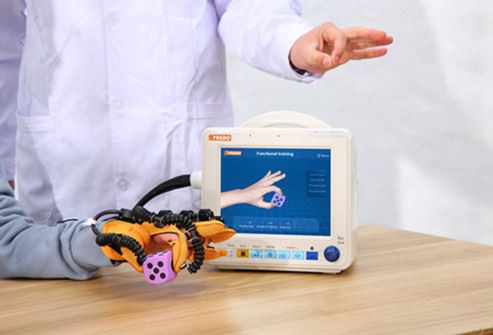
Syrebo™ hand reabilitação system is small and lightweight, which provides convenience for super-early clinical reabilitação.
Compact host: The net weight is only 3kg. The host design can run the world's leading software-aware AI-assisted algorithm at high speed, assisting therapists to help patients complete scientific and effective training.
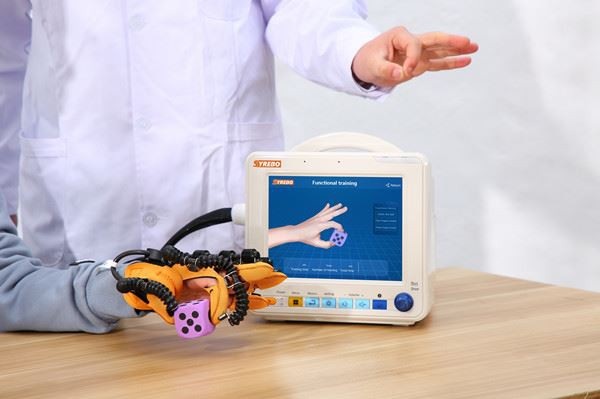
Equipped with lithium battery: Containing ultra-large capacity lithium battery, it is not limited by power supply and venue, helping patients to recover anytime, anywhere.
Lightweight gloves: The gloves are made of imported customized full-soft materials, and the weight is less than 150g; combined with the half-section design, it is breathable, skin-friendly, and non-irritating;
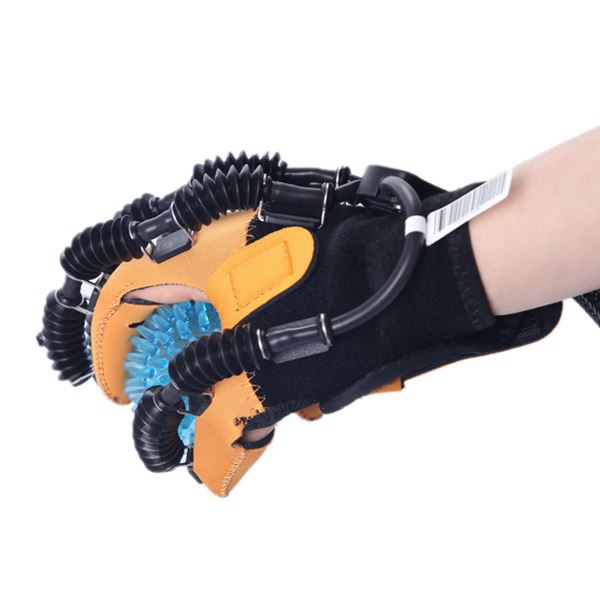
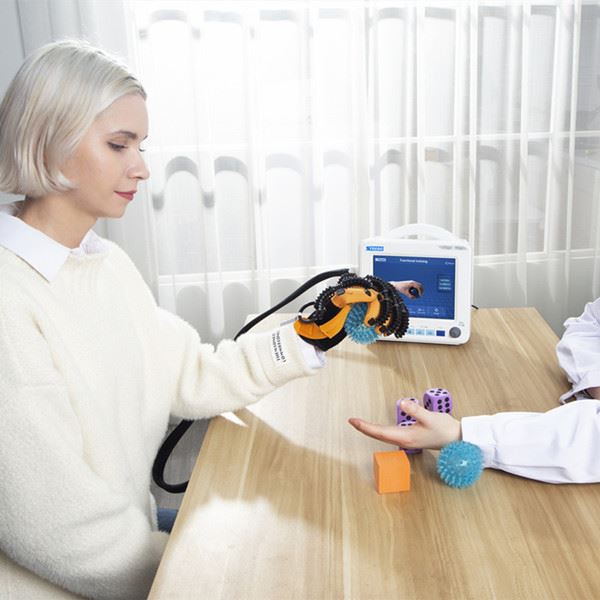
The use of high-precision bending sensors and spatial attitude sensors can not be restricted by space, angle, direction, environment, etc., so that patients can complete data collection and perform functional training in different situations; pneumatic bionic muscle flexible drive training provides safety recuperação.
The hand function reabilitação system has a variety of training modes, suitable for full-cycle reabilitação of patients to meet the needs of various clinical patients.
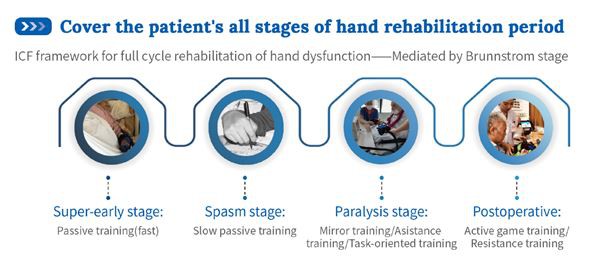
The passive training mode can provide patients with ultra-early passive exercício training, while saving the labor cost and time cost of the therapist. The assistance training mode is mainly used when acidente vascular cerebral patients in the flaccid paralisia stage experience slight movements. The pneumatic reabilitação gloves of the hand function reabilitação system can be worn to monitor the patients' slight movements and assist the patients to complete the training movements, greatly improving the patients' confidence in treatment. Spasticity after acidente vascular cerebral is one of the main causes of disability. In modern reabilitação medicine, robotic gloves of the hand function reabilitação system can be used to help patients prevent palmar spasm and effectively improve the function of the hemiplegic side of the hand.
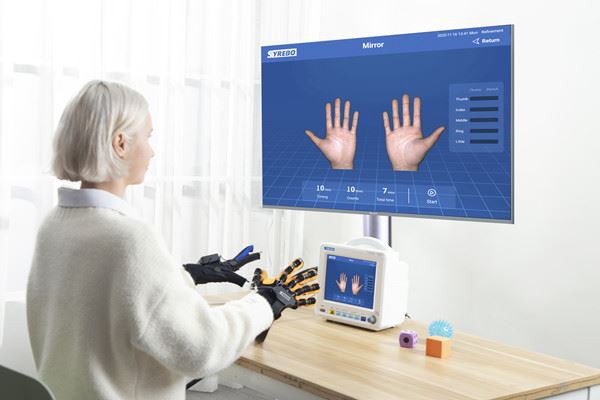
In addition, Syrebo™ hand reabilitação system has various training modes of active consciousness combined with passive movement, such as task-oriented training mode, fine motor training mode, mirror training mode, etc., which can promote the recuperação of brain nerve pathways of patients, reshape brain function, and improve hand function.
The portable design of Syrebo™ hand reabilitação system meets the needs of clinical mobile reabilitação, assisting therapists to achieve "one-to-many" reabilitação training; providing patients with full-cycle reabilitação, helping patients with ultra-early acidente vascular cerebral hemiplegia to achieve bedside reabilitação, eliminating "" Disuse syndrome", which promotes the recuperação of brain nerves and shortens the process of hand function recuperação.